ALL PRODUCTS IGSL INTERNATIONAL CERTIFIED


The Scientific Journey of Malachite: Properties, Types and the Truth Behind Crystals
Malachite, with its vibrant green color and captivating banded patterns, has captivated us for thousands of years. So, what are the scientific facts behind this stunning stone? In this comprehensive article, we'll examine malachite's chemical and physical properties , its formation processes , its various types (e.g., azurite-malachite combinations), and how its unique color patterns are created . We'll also explore how malachite crystals are examined using advanced analytical techniques and the scientific evaluation of its purported benefits in alternative medicine. This information, compiled from scientific journals and reliable sources, will allow us to examine malachite from both a geological and technical perspective.
Chemical and Physical Properties of Malachite Stone
Malachite is a copper carbonate hydroxide mineral with the chemical formula Cu₂CO₃(OH)₂ ( Malachite - Wikipedia ). This formula indicates that malachite contains copper, carbonate (CO₃), and hydroxide (OH) groups. Here are the characteristics and defining characteristics of malachite :
-
Color: Varying from vibrant bright green to dark green. Often seen in light and dark green banded patterns . Shades of yellowish green may be observed when sliced thinly or exposed to light ( Malachite | Properties, Formation, Uses and Deposits ).
-
Luster: Generally has a vitreous luster. Fibrous aggregates (fine needle-like crystals) exhibit a silky luster, while dense, massive masses may appear more dull. ( Malachite | Properties, Formation, Uses and Deposits ).
-
Streak Color: Its color is light in powder form; it leaves a light green mark when rubbed on a porcelain plate ( Malachite | Properties, Formation, Uses and Deposits ).
-
Hardness: Approximately 3.5–4 on the Mohs scale ( Malachite | Properties, Formation, Uses, and Deposits ). This means it is relatively soft; it can be scratched with the tip of a steel knife.
-
Density: Its specific gravity is in the range of ~3.6 – 4.0 g/cm³ ( Malachite | Properties, Formation, Uses and Deposits ). This is denser than the average rock, due to the heavy copper element it contains.
-
Crystal System: It crystallizes in the monoclinic system ( Malachite - Wikipedia ). Malachite crystals can be prismatic and acicular, but distinct, large individual crystals are rare.
-
Habitus (Shape): It generally accumulates in botryoidal (rounded masses resembling bunches of grapes), banded massive forms, or stalagmitic (stalactite) forms ( Malachite - Wikipedia ). Fine needle-like crystals may aggregate to form radial patterns. Well-formed individual crystals are rare.
-
Fracture and Cleavage: The fracture surface may be irregular or subconchoidal (in the form of small semicircles) ( Malachite - Wikipedia ). It shows perfect cleavage in certain planes (e.g., marked cleavage in the {201} plane) ( Malachite - Wikipedia ).
-
Other Diagnostics: When in contact with dilute hydrochloric acid, it bubbles (CO₂ gas due to its carbonate content) to form a green solution ( Malachite | Properties, Formation, Uses and Deposits ). This is one of the chemical diagnostic tests for malachite, and the solution turns green due to the copper it contains, copper(II) chloride.
The green color of malachite is due to the copper(II) (Cu²⁺) ions in its structure ( Malachite - Wikipedia ). The presence of the copper element gives malachite its characteristic color, which is permanent and does not fade in sunlight ( Malachite: Uses and properties of the mineral and gemstone ). Indeed, malachite has been an important green pigment throughout history because it is lightfast and easily ground into powder ( Malachite: Uses and properties of the mineral and gemstone ).
Formation of Malachite Stone and Geological Processes
How is malachite formed? Geologically, malachite is a secondary copper mineral . This means it is not formed directly by the crystallization of primary magma, but rather by the weathering and transformation of copper-bearing primary minerals . It typically forms in the upper layers of copper deposits, in oxidation zones enriched by the atmosphere and surface waters ( Malachite - Wikipedia ) ( Malachite: Uses and properties of the mineral and gemstone ). The processes that contribute to its formation can be summarized as follows:
-
Weathering of Primary Copper Ores: Copper-bearing sulfide minerals such as chalcopyrite and bornite, found deep below, come into contact with rainwater and oxygen over time. During this weathering process, the primary minerals oxidize, releasing their copper (Cu²⁺ ions are formed) (Malachite | Properties, Formation, Uses, and Deposits ). For example, chalcopyrite (CuFeS₂) can react with oxygen and water to form copper sulfate and iron sulfate solutions, which contain Cu²⁺ ions.
-
Carbonate-Rich Groundwater: Released copper ions meet carbonate sources in rocks. Copper ore deposits are often adjacent to carbonate rocks such as limestone, which provide abundant carbonate (CO₃²⁻) ions ( Malachite - Wikipedia ). Rainwater adds carbonate ions to the circulation by passing through carbonate layers of the soil or dissolving CO₂ with groundwater.
-
Malachite Precipitation: Chemical precipitation occurs when copper ions combine with carbonate and hydroxide ions. This combination forms the copper carbonate hydroxide mineral, malachite ( Malachite | Properties, Formation, Uses, and Deposits ). During the reaction, the copper combines with the bicarbonate/carbonate in the water, releasing CO₂ gas, and the green malachite precipitates as a solid. According to a summary equation:
Cu²⁺ (solution) + CO₃²⁻ (solution) + OH⁻ → Cu₂CO₃(OH)₂ (solid malachite) + CO₂ (gas) + H₂O
(This equation shows the formation of malachite in simplified form.) -
Deposition Environment: Malachite generally accumulates in cracks, cavities, or porous structures of rocks ( Malachite: Uses and properties of the mineral and gemstone ). It can form stalactites and dripstone-like formations in cavernous spaces. Flowing groundwater deposits malachite as crusts on the walls of rock cracks as copper-laden solutions slow down, or fill the voids, forming botryoidal (spherical, grape-like) masses ( Malachite - Wikipedia ).
-
Accompanying Minerals: Malachite does not form alone; it is often seen with other copper minerals that form in close proximity. The most common companion is the blue copper carbonate mineral azurite ( Malachite - Wikipedia ). In fact, azurite and malachite are often found side by side or intergrown. In addition, minerals such as cuprite (copper oxide), chrysocolla (copper silicate), and calcite (calcium carbonate) may accompany malachite in the same copper-rich environment. ( Malachite | Properties, Formation, Uses and Deposits ) ( Malachite: Uses and properties of the mineral and gemstone ). Limestones play an indirect role in the formation of malachite; they provide both a carbonate source and an alkaline environment suitable for the neutralization and precipitation of the copper solution. ( Malachite - Wikipedia ).
Consequently, malachite is a second-generation mineral that accumulates in oxidized zones near the surface of copper mines. Chemical reactions occurring over years at the primary ore deposits yield this beautiful green stone in the form of veins or nodules. Indeed, in the past, large masses of malachite were considered "precursors to the ore" in the upper reaches of copper mines and were exploited.
Malachite Types and Variations
In nature, malachite can occur in various shapes and combinations. In addition to the classic banded malachite , it can also take on various appearances depending on the crystal size and formation conditions. Here are the main variations and types of malachite:
-
Banded Solid Malachite: This is the most recognizable form of malachite. Layers of microcrystalline malachite accumulate on top of each other, forming concentric bands of light and dark green. When cut and polished, circular or wavy patterns reminiscent of agate are revealed. ( Malachite Morphology — Part I - Rock & Gem Magazine ). The Democratic Republic of the Congo (formerly Zaire) and the Urals in Russia are famous for their large blocks of banded malachite. This banded structure is the result of the malachite growing in layers over many years, each band representing a growth stage, much like the rings of a tree.
-
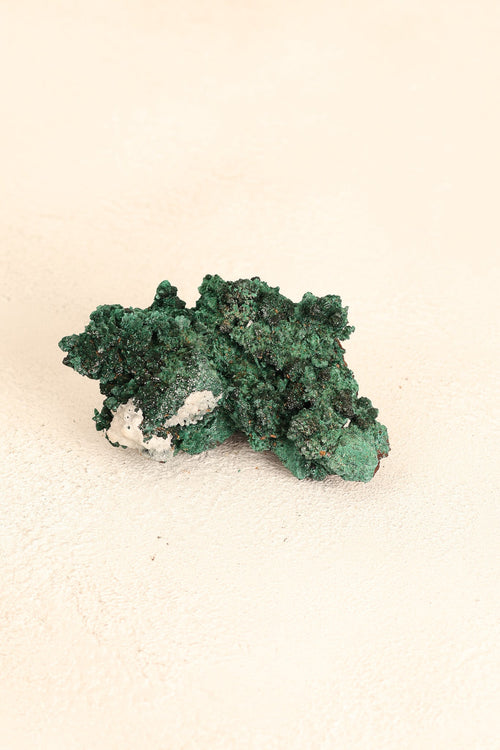
Velvet Malachite: Some malachite specimens have a velvety texture due to the fine needle-like crystals that cover their surfaces. The green needle clusters, arranged parallel or radially, create a lustrous, silky appearance ( Malachite Morphology — Part I - Rock & Gem Magazine ). This type of malachite is often called " velvet malachite " and is highly sought after by collectors. The countless small light-reflecting crystals give the stone a vibrant shimmer.
-
Stalactite and Stalactitic Malachite: Malachite can form as green cylindrical columns suspended from the ceiling in mine galleries or natural cave cavities. These stalactite -like forms are formed by dripping copper-laden water gradually depositing malachite ( Malachite Morphology — Part I - Rock & Gem Magazine ). When cut crosswise, they reveal layered rings resembling onion skins. Forms resembling radial rosettes, called "flower malachite," also fall into this category.
-
Azurite-Malachite Combination (Azurmalachite): Because malachite is often found with azurite, specimens sometimes exhibit both blue and green components within a single stone. Such stones are called azurite and are particularly striking because they contain both the deep blue of azurite and the green of malachite. ( Azurmalachite: Properties, Formation, Uses, and Resources » Geology ) ( Azurmalachite: Properties, Formation, Uses, and Resources » Geology ). Azurmalachite is generally formed by the partial transformation of azurite into malachite. During geological processes, azurite can pseudomorph into green malachite due to changes in chemical equilibrium; that is, malachite that retains its original crystalline form is formed. ( Malachite Morphology — Part I - Rock & Gem Magazine ). The resulting stone, with its intertwined blue-green patterns, becomes a unique semi-precious stone. It is frequently used in jewelry, especially for decorative purposes.
-
Crystalline Malachite: Although extremely rare, malachite can be found as well-formed crystals. It typically occurs as short, prismatic, or acicular crystals, and individual crystals larger than 1-2 cm are considered exceptionally beautiful collector's items ( Malachite Morphology — Part I - Rock & Gem Magazine ). Green malachite crystals several centimeters across, extracted from the Mashamba mine in Congo in the late 20th century, were enthusiastically hailed by mineralogists as "primary malachite" ( Malachite Morphology — Part I - Rock & Gem Magazine ). However, even these crystals are likely secondary formations, replacing azurite. Therefore, it is extremely rare for pure malachite to spontaneously develop large crystals in nature.
The variations above summarize the visual forms malachite can take, depending on its environment and formation conditions. Although the shape and color distribution vary, the chemical composition of all these examples remains Cu₂CO₃(OH)₂ ; only their crystallization patterns differ.
Formation of Malachite Stone Colors and Patterns
When you think of malachite, the first thing that comes to mind is its vibrant green hues and hypnotic patterns . The reasons behind these colors and patterns are entirely a matter of science:
-
Copper's Green: Malachite's green color is primarily due to the copper(II) ions in its structure. Copper gives many compounds their blue-green hues; for example, in malachite, Cu²⁺ ions absorb certain wavelengths of light, resulting in only green reflections ( Malachite - Wikipedia ). Interestingly, malachite's color does not fade over time or with exposure to light because it is an inorganic pigment and chemically stable ( Malachite: Uses and properties of the mineral and gemstone ). For this reason, ancient painters used malachite powder to create a permanent green dye (some emerald green hues in Renaissance paintings are malachite pigment).
-
Light-Dark Green Shade Differences: The shades of green in malachite can vary depending on factors such as the size and purity of the crystals. Thin, fibrous portions or rapidly deposited layers are generally light green, while denser, more pure copper-containing layers reach a deep emerald green ( Malachite | Properties, Formation, Uses, and Deposits ). Sometimes, the admixture of other elements, such as zinc, can slightly affect the color tone; indeed, in some malachite samples, 1-2% Zn can replace Cu ( Malachite R050531 - RRUFF Database: Raman, X-ray, Infrared, and Chemistry ). However, color differences are generally the result of fluctuations in chemical concentrations in the conditions under which malachite was formed.
-
The Mystery of Banded and Ringed Patterns: Malachite's most striking feature is the dark and light green concentric rings and wavy bands visible when cross-sectioned. These patterns are the product of malachite's layered growth pattern. As minerals grow, environmental conditions (ionic ion concentration, pH, CO₂ content, temperature, etc.) can change over time. These cyclically changing conditions cause malachite to grow as a darker, purer layer for a while, followed by a lighter, distinct layer. As a result, rings form on top of each other. Scientists have proposed an intriguing mechanism for the formation of these ringed bands in malachite: chemically oscillatory reactions in the formation of botryoidal malachite . A 2020 study examined the internal structures of botryoidal malachites and demonstrated the possibility of chemical oscillations similar to the classic Belousov-Zhabotinsky reaction ( Chemically oscillating reactions in the formation of botryoidal malachite ). In short, as malachite deposits underground, periodically recurring chemical fluctuations (such as intermittent CO₂ release from the decomposition of organic matter) leave a malachite layer with different properties with each wave. This creates patterns with almost perfectly circular, evenly spaced bands ( Chemically oscillating reactions in the formation of botryoidal malachite ). One band may contain more copper, while the next may be more porous or have a different crystal size; this also affects the hue. Consequently, rhythmic changes in malachite's growth conditions create those beautiful patterns within the stone, virtually a signature of nature.
-
Agate-like Structure of Patterns: The banded structure in malachite is often likened to the concentric patterns in agate, and indeed, the formation mechanism may be similar. In both cases, silica or carbonate gradually precipitates to fill a void, with each filling phase creating a line. In the malachite sample, layers grow from the void walls toward the center, resulting in rings known as "eyes " when cut. ( Malachite: Uses and properties of the mineral and gemstone ). Indeed, high-quality banded malachite slices are used for decorative purposes in a variety of objects, from tabletop coverings to watch dials, and these natural patterns enrich the design.
In short, malachite's captivating appearance is entirely a product of nature's chemical and physical processes. The optical properties of copper give it its green color, while fluctuating environmental conditions imprint patterns on the stone during growth.
Malachite Stone Benefits: Scientific Facts
Malachite has been used as jewelry, ornaments, and even talismans in various cultures for centuries. Today, in the world of alternative medicine and energy crystals, malachite is attributed with many metaphysical benefits . So, what are the scientifically proven benefits of malachite? In this section, we evaluate these claimed benefits solely based on scientific research .
-
Copper Ore and Its Historical Importance: Malachite holds a significant place in human history because it is an easily recognizable indicator of copper ore . In ancient times, malachite was one of the first ores used to extract copper ( Malachite: Uses and properties of the mineral and gemstone ). Archaeological evidence suggests that malachite was mined and copper was extracted in regions such as Egypt and Israel (Timna Valley) from the 4th millennium BC onwards ( Malachite - Wikipedia ). In this respect, malachite provided significant benefits to civilizations during the transition to the Bronze Age: it could be smelted and transformed into metallic copper. While pure copper ores exist in the modern era, malachite has become a secondary source of economic copper, its historical importance is undeniable.
-
Pigment and Cosmetic Uses: Malachite was used as a natural green pigment. Powdered malachite mineral served as a green dye in wall paintings, miniatures, and paints from antiquity to the Middle Ages. For example, some of the durable green colors in famous Renaissance paintings contain malachite pigment. Additionally, malachite powder was used as eye makeup (eye shadow) in Ancient Egypt ( What was ancient Egyptian makeup made out of? - Quora ). Scientists suggest that the Egyptians' malachite eyeliner may have reduced eye infections thanks to the microbial-killing properties of copper compounds. Indeed, copper's antimicrobial properties are scientifically known; copper-containing substances can kill bacteria and fungi ( The Use of Copper as an Antimicrobial Agent in Health Care... ). Therefore, it can be said that malachite eye makeup in ancient times was not only cosmetic but also likely had a protective function. There was also a belief in the Middle Ages that malachite powder could heal wounds or skin diseases, but these are not systematically documented medical benefits.
-
Jewelry and Psychological Effects: Bright green malachite is popular as a piece of jewelry and ornaments. When used as a necklace, bracelet, or ring stone, it provides both an aesthetic appeal and can provide psychological morale . Wearing a beautiful stone is known to have self-esteem-boosting and stress-reducing effects (either placebo or psychological). While this isn't a direct "energy" specific to malachite, it could be considered an indirect benefit.
-
Claims in Alternative Medicine: Malachite is associated with many benefits in crystal healing, including "transformational, protective, and heart chakra-opening." However, these claims have not been scientifically verified . To date, there are no studies published in peer-reviewed scientific journals demonstrating that touching malachite on the human body produces any physiological improvement. Therefore, popular claims such as malachite's ability to relieve stress, promote mental balance, or cure physical ailments cannot be considered scientific; they are based more on belief and experience. It's important to note that malachite powder or its raw, unpolished form can be toxic: Because malachite contains a high amount of copper, ingestion or inhalation of its powder can lead to copper poisoning. Therefore, far from providing any "benefits," direct physical contact or consumption of malachite can be dangerous. Polished malachite used in jewelry is generally stable and harmless to the touch, but malachite jewelry should not be immersed in water or subjected to abrasive treatments.
Scientific summary: Malachite's most concrete proven "benefit" is its historical use of copper metal, and its cultural and economic value today in pigments and jewelry. Other positive health effects are either indirect/psychological or claims that have not yet been researched. Therefore, the miraculous healing powers attributed to malachite should be considered traditional beliefs, not scientific facts.
Advanced Analysis, Laboratory Synthesis and Spectroscopy
Malachite is not only a gemstone or a collectible; it's also a material scientists study in the laboratory. Advanced analyses of malachite in the fields of mineralogy and materials science allow us to understand its structure and composition more deeply. Additionally, malachite can be synthesized and produced as a pigment in chemical laboratories.
Synthesis of Malachite in the Laboratory: Interestingly, malachite can be obtained artificially using simple chemical methods. One of the classic experiments in chemistry education is to produce malachite by mixing a copper sulfate solution with a sodium carbonate solution. For example, when sodium carbonate [Na₂CO₃] solution is added to a blue solution of copper(II) sulfate pentahydrate [CuSO₄·5H₂O], the following reaction occurs:
2 CuSO₄·5H₂O (aq) + 2 Na₂CO₃ (aq) → Cu₂CO₃(OH)₂ (s) + 2 Na₂SO₄ (aq) + CO₂ (g) + 9 H₂O (l)
As shown in this equation, malachite [Cu₂CO₃(OH)₂] precipitates as a solid, leaving sodium sulfate in solution as a byproduct and releasing carbon dioxide gas ( Synthesis of Malachite and Verdigris - : Synthesis of Malachite and Verdigris Purpose To make - Studocu ). The resulting solid is bluish-green fine particles; this is actually the powdered form of natural malachite. This synthetic malachite, dried and powdered, can be mixed with a binder and used as a paint pigment ( Synthesis of Malachite and Verdigris - : Synthesis of Malachite and Verdigris Purpose To make - Studocu ). Historically, humans have produced artificial green pigments through similar means (such as dissolving copper ores with acid or exposing copper to vinegar vapor to produce verdigris ), but growing crystalline malachite directly is possible in modern studies. Indeed, small malachite crystals have been grown in the laboratory using low-temperature hydrothermal methods or slow crystallization in gel media. These synthetic crystals are helping scientists understand the properties of natural malachite.
Spectroscopic and Structural Analyses: Various advanced techniques are used to determine the chemical structure and identification of malachite:
-
X-ray Diffraction (XRD): One of the primary methods for determining the crystal structure of malachite. XRD analysis confirms the monoclinic structure of a malachite sample by obtaining characteristic diffraction patterns. For example, a malachite sample in the RRUFF mineralogy database was identified by XRD and confirmed as Cu₂CO₃(OH)₂ by chemical analysis ( Malachite R050531 - RRUFF Database: Raman, X-ray, Infrared, and Chemistry ). XRD is also used to distinguish malachite from other similar-looking minerals; each mineral has a unique "fingerprint" diffraction pattern.
-
Raman and Infrared (IR) Spectroscopy: Malachite possesses specific vibrational frequencies related to the carbonate and hydroxide groups in its molecular structure. Characteristic peaks resulting from the vibrations of the CO₃ group and OH groups in malachite crystals can be detected with Raman spectroscopy ( chemically oscillating reactions in the formation of botryoidal malachite ). For example, in the Raman spectrum of malachite, a strong band around 1090 cm⁻¹ corresponds to the symmetric stretching vibration of carbonate, while bands related to O–H stretching are observed around 3400 cm⁻¹. This technique is widely used to determine whether a green pigment in artwork is malachite; the pigment can be identified by non-destructively taking the Raman spectrum of a small area. Raman analyses have been developed by academic studies examining the spectral behavior of malachite and azurite even at low temperatures (77 K) ( Raman spectroscopic study of azurite and malachite at 298 and 77 K ). Similarly, FT-IR (Fourier Transform Infrared) spectroscopy is also used in the identification of malachite, because the carbonate group has a distinctive double peak in the IR spectrum (approximately in the range of 1400-1500 cm⁻¹) ( Chemically oscillating reactions in the formation of botryoidal malachite ).
-
Elemental Analysis: Because malachite contains the element copper, techniques such as X-Ray Fluorescence (XRF) or Atomic Absorption can be used to determine the copper content of a stone. This allows us to determine the purity of the malachite and whether traces of other elements (e.g., zinc and iron) are present. Microprobe (electron microprobe) analyses have shown that zinc substitution can be observed in malachite crystals at a level of a few percent ( Malachite R050531 - RRUFF Database: Raman, X-ray, Infrared, and Chemistry ). This indicates the presence of zinc minerals in the environment in which it was formed.
-
Microscopic Examination: When examined with a polarizing petrographic microscope, malachite is an optically biaxial (-) mineral, recognizable by its distinct green pleochroism (a change in color tone when viewed from different axes) in thin sections. Detailed microscopic examination of the internal bands reveals thin layers and impurity lines formed during deposition. Scanning with an electron microscope (SEM) reveals the radial structure of the acicular crystals of velvet malachite, or the curved microcrystalline surfaces of botryoidal malachite.
These advanced techniques also allow us to infer the conditions under which malachite formed in nature . For example, by examining the organic matter residues or trace element distribution within malachite, we can understand whether its past formation environment was hydrothermal or atmospheric ( chemically oscillating reactions in the formation of botryoidal malachite ). Spectroscopic data is also critical for distinguishing malachite from azurite in samples where the two minerals occur together; the Raman/IR bands of azurite and malachite differ.
As a result , malachite is under scrutiny not only on jewelry counters but also in laboratories. Both synthetic production experiments and non-destructive analysis techniques allow us to deeply understand the chemical, structural, and optical properties of this stone. This allows us to unravel its geological story in nature and gain scientific insights into its preservation and identification.
Conclusion
Malachite's scientific journey extends from its journey underground in copper mines to experiments on laboratory benches. Understanding its chemical and physical properties allows us to understand why this stone is so beautifully green and why it exists in certain shapes. Understanding its geological formation processes allows us to see that each piece of malachite is a chemical painting, the product of hundreds or even thousands of years. By examining its types and variations , we appreciate the processes behind the banded patterns and azurite-malachite mixtures that nature creates, like works of art. Furthermore, when evaluating its benefits and uses , we can separate scientific facts from superstition and place malachite in its proper historical and industrial context. Finally, when we examine malachite in the light of advanced analytical techniques , we understand that the interaction between humans and the stone is no longer merely aesthetic but also informative.
Offering one of the most beautiful shades of green, malachite is a stone that has captured the attention of both ancient civilizations and modern science. When we hold it in our hands, we are not only holding an ornament but also the scientific story behind the crystals . We hope to grasp the magic of malachite with both our eyes and our minds.
Source
-
Hobart M. King, "Malachite: Uses and properties of the mineral and gemstone" , Geology.com . Information on malachite's chemical composition, historical use as a copper ore, and pigment properties ( Malachite: Uses and properties of the mineral and gemstone ) .
-
Wikipedia (English) - "Malachite" : General information on the formula, crystal system, formation conditions and history of malachite ( Malachite - Wikipedia ) ( Malachite - Wikipedia ).
-
Geology Science (tr.geologyscience.com) , "Malachite" : Turkish compilation of the mineral malachite; its physical/optical properties, formation and uses are detailed ( Malachite | Properties, Formation, Uses and Deposits ) ( Malachite | Properties, Formation, Uses and Deposits ).
-
Bob Jones, "Malachite Morphology — Part I" , Rock & Gem Magazine , 2018. The different forms of malachite (banded, velvety, pseudomorph, etc.) and observations on its formation are presented ( Malachite Morphology — Part I - Rock & Gem Magazine ) .
-
Dominic Papineau, "Chemically oscillating reactions in the formation of botryoidal malachite" , American Mineralogist , 105(4), 2020. Investigation into whether concentric band patterns in malachite can be formed by chemical oscillating reactions ( Chemically oscillating reactions in the formation of botryoidal malachite ) .
-
NCBI - The Use of Copper as an Antimicrobial Agent in Health Care : A study highlighting that the antimicrobial effects of copper have been known for centuries ( The Use of Copper as an Antimicrobial Agent in Health Care... ). This supports the possible antibacterial benefits of ancient cosmetics containing malachite (copper carbonate).
-
RRUFF Mineral Database – "Malachite R050531" : XRD confirmed identity and Raman spectrum data of malachite sample ( Malachite R050531 - RRUFF Database: Raman, X-ray, Infrared , and Chemistry ). It also indicates that there may be minor Zn substitution in the malachite composition.
-
Studocu – "Synthesis of Malachite and Verdigris" : Experimental information explaining the formula of malachite synthesis and pigment production by the reaction of copper sulphate and sodium carbonate ( Synthesis of Malachite and Verdigris - : Synthesis of Malachite and Verdigris Purpose To make - Studocu ).
-
Geology Science (tr.geologyscience.com) , "Azurmalachite" : Information on the definition, composition and formation of azurite-malachite composite stone (azurmalachite) ( Azurmalachite: Properties, Formation, Uses and Resources » Geology Science ) ( Azurmalachite: Properties, Formation, Uses and Resources » Geology Science ).
-
Related Academic Sources and Articles: Additional literature was reviewed on topics such as Raman spectroscopy of azurite and malachite (Analytical and Bioanalytical Chemistry, 2007) ( Raman spectroscopic study of azurite and malachite at 298 and 77 K ), use of malachite in ancient Egyptian cosmetics (Scientific Reports, 2022). These sources support the specific scientific facts presented in the text.